COOL WHITE. . . MAN

Posted in Commentary, Darkroom, Photography on July 18th, 2010 by Administrator

Seem things continue to change at an alarming rate. Several years ago, maybe 12-15 to be honest, I bought some supposedly daylight balanced fluorescent lamps for the kitchen fixture. They put out this really annoying, kind of brownish light that I just could not stand. They were eventually banished to the garage where they finally burned out and were discarded. It was back to the old standard Cool White fluorescent lamps and that awful color cast they generate. Fast forward to our current world and I saw some information about a Compact Fluorescent (CFL) lamp that is 5,000k and touted to be Full Spectrum. Wow! Now that is more what I was looking for.

I bought a CFL lamp that is dimmable, 5,000k and Full Spectrum for another project I was working with. I was so impressed with the light that I searched out some four footers for the kitchen fixture. Once installed I was really impressed with the fact that the room no longer had that sick green/blue light I have become so accustom to from the run-of-the-mill Cool White lamp. The kitchen light looked so good compared to the ones in the darkroom, I knew they were next.

I did take the time to look at a few photographs under both lights and the difference is remarkable. It is always difficult for me to judge print color cast under fluorescent light. These new Full Spectrum lamps deliver a much more natural light that I really like. If you haven’t looked into these new generation lamps, you might just get a pleasant surprise.

Little else to say, other than the latest batch of Full Spectrum fluorescent lamps are impressive and I really do not want to go back to Cool White. . . Man!

WHERE DO I START?

Posted in Darkroom, Film, How-To, Photography on May 17th, 2010 by Administrator

The question comes up every now and again about getting started processing and printing B&W film in the wet darkroom. Seems that as more and more people come to photography via the digi-snapper route, they eventually become interested in that antiquated art form known as Film. I have said this so many times, have been cursed and belittled by some for my comments, but here it is again. Digital is not a replacement for film. It is simply another art form. There I have said it one more time. If you don’t get it, too bad. Get over it.

Now, back to the subject for today, how to get started processing and printing film in the wet darkroom. The question is, where and how do I start? What do I need? Is it hard to do? There are many answers to these questions. You can take a class, find a workshop, or study with someone that is willing to teach you. Or, my favorite method of doing anything. . . find a good book and learn on your own.

If you choose my method the next question is, what book? There are many good books on getting started with film. Also, there are a lot of good web sites on the Internet that will help you. My recommendation is to start where I did over thirty years ago. I found a great book that is geared to the rank beginner. This book does not outline anything that is set in concrete, but if you follow it you will process a roll of film and make prints. Wherever you go from there is up to you. This is where I started and I can say it worked the first time and though I do not use much of the techniques or materials in the book anymore, this was the launching pad for me to move to more advanced techniques. Some of the materials and chemicals are no longer available, specifically the chapters on color, but the basic B&W techniques still apply. This book is a bare-bones, get you started text.

OK. . . enough of my book review, time to get down to brass tacks. First I have to say that the book I recommend is long out of print. But, the good news is the title is readily available on the used market and it is not expensive. I found several copies on the Internet for $1.00! If you are interested in getting started in the wet darkroom, here is a good place to begin. It worked for me, I am sure it will work for you also. Here it is;

“DO IT IN THE DARK”
by Tom Burk
H. P. Books 1975
ISBN 0-912656-28-X

This is one place to start. . .

JB

THE VARIABLE CONTRAST COLD LIGHT

Posted in Darkroom, How-To, Photography on May 3rd, 2010 by Administrator

papercurvefigureThe dual grid, Variable Contrast Cold Light head (VCCL), is a great device for your enlarger if you print on black & white VC papers. These heads allow you to dial in any contrast grade your VC paper is capable of producing. You have continuously variable contrast at your fingertips. And, yes they do work. The trouble is, every paper is different. Setting the dial on the head to any random equal setting may or may not produce a grade #2 contrast. Worse yet, what two settings should you choose?

When you start using a new VCCL head you are now faced with a quandary. How do you calibrate this thing so you have some idea what paper grade you are actually getting? Did you know you can calibrate a VCCL head to a known standard? You can know what settings of the blue and green grid will give you an equivalent grade #2, or #3, or anything within the range of the paper!

Yes you can calibrate a VCCL head, and here is how it can be done. Look at the article “USING BTZS TO CALIBRATE YOUR VARIABLE CONTRAST COLD LIGHT HEAD” originally published in the Sep/Oct 2007 issue of View Camera Magazine in the ARTICLES area of our web site.

DON’T SCRATCH YOUR SINK

Posted in Darkroom, How-To, Photography on April 2nd, 2010 by Administrator

dd1If you build you own darkroom sink or use a commercially available unit, you need something to protect the floor of the sink from scratches and abrasions. It has been a common practice to construct wooden Duck Boards for the bottom of the darkroom sink. These work well, they protect the sink, and allow water to drain, but wood is hard to waterproof and keep from warping.

I have heard of people using plastic lighting grids or plastic rods in the sink, but I have never tired them. I have constructed and used the usual wooden Duck Boards for years. Then I found something even better.
dd2
Dri-Dek® is sold as an anti-fatigue flooring for use in commercial work areas such as industrial manufacturing or commercial kitchens. It comes in 12” interlocking squares or rolls. This is a soft, flexible Vinyl that is perfect for the floor of a darkroom sink.

We installed Dri-Dek® in our sink two years ago and it has been an excellent investment. Water easily runs through and under the lattice work, it protects the sink floor, and it provides a soft, yet firm surface on which to work. Note, that the Vinyl does stain when exposed to some chemicals, like Amidol and Pyro, but it has remained flexible and I would not hesitate to recommend it to replace those old, warped wooden Duck Boards.

For more information about Dri-Dek® click HERE.

2010 ADVENTURES IN THE DARKROOM

Posted in Darkroom, Film, Photography on February 8th, 2010 by Administrator

Time to start processing the film from the last trip to Utah. We spent 30 days on the road and photographed 20 days. That kind of working schedule generates a lot of LF and ULF film. Now comes the time to head to the darkroom for a little developing. Should take about 30 days to finish all of the film. Then we have to catalog and file, then proof to see what we have. Soon we will have some new film to start looking at with an eye toward making prints.

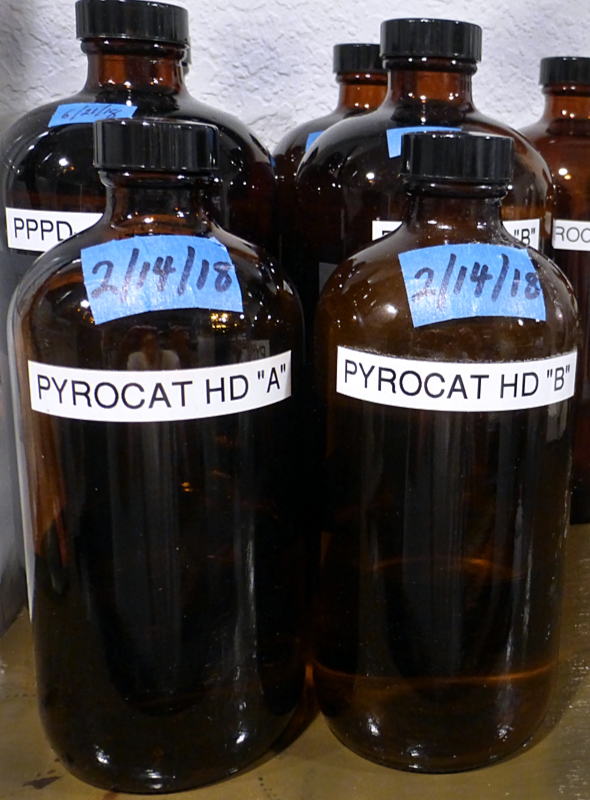
All film will be processed in a scratch-mixed Pyro developer, in small batches, by hand in open trays. Typically a day of processing will consist of 3-4 batches, normally totaling no more 30 sheets. We never try to push and do too many, if you get really fatigued, it is easy to make mistakes. This film is the culmination of hours of traveling and heaving heavy cameras in deep snow and ice, we do not want to do anything foolish now.

Hopefully we will find a few keepers in this batch of film. Watch here for more information and maybe a few new photos on the web site.

JB & Susan

THE SINK FINISH

Posted in DIY, Darkroom on May 21st, 2009 by Administrator

newsink_35Once you become a serious darkroom worker you will eventually want a real darkroom sink with running water. The question is, to buy, or to build? Certainly, if you have deep pockets, you can buy a commercial stainless steel sink. You can even have a stainless sink custom fabricated. Just be forewarned, you are looking at a serious amount of money.

What most do is build their own sink, typically from wood. This is my favorite construction technique and allows me to build a very functional sink to any size required. In the previous post titled “NOT THE KITCHEN SINK” we showed what it took to build a large darkroom sink from wood. Robust construction is essential to make sure the sink does not flex. Flexing can cause the finish to crack and begin to leak.

My philosophy of sink building is to build the thing like a boat. Using construction robust enough to sail the ocean. That way it is strong enough to stand up to most anything. Once complete, I like to climb into the sink and jump up and down. If nothing moves, creaks, or breaks, I am satisfied that I have a good strong sink.

Waterproofing is the next order of business. Caulking all seams is a must to insure no leaks. Next comes some form of durable, waterproof coating. I built one sink years ago and used fiberglass. Never again! Way too messy for me, and I hate working with the stuff.

After much research I found a suitable coating for my darkroom sink. Tile-Clad® HS Epoxy is a two-part, commercial-grade, epoxy-polyamide coating from Sherwin-Williams. This epoxy paint is used in power plants, offshore structures, schools, storage tanks, laboratories, hospitals and marine applications. This stuff dries rock hard and is near impervious to most chemicals.

I have found that two generous coats of Tile-Clad® makes a great smooth waterproof finish for a darkroom sink. You can also have the paint tinted to most any color you desire. Most any Sherwin-Williams store should have Tile-Clad® and be able to tint it for you. Be prepared, this material is not cheap. Seven years ago when we built our last sink it was about $110.00 for a gallon of part ‘A’ and part ‘B’ which, when mixed, makes two gallons of paint.

The main points to keep in mind when building a darkroom sink is make it robust in construction, waterproof, and resistant to chemicals. Whatever finish you choose, whether it be fiberglass or Tile-Clad®, if the sink flexes, the finish will crack. Build your sink like your life depends on its integrity and you will never have leaks nor have to build another. . . unless. . . you decide you need a larger one!

For those interested in why we chose this chocolate brown color, the first sink I built was white. Amidol and Pyro left stain spots all over the sink. We chose the closest color to the stains from the color swatches from Sherwin-Williams and had the paint tinted that color. Developer stains do not show!

YOUR DARKROOM

Posted in Commentary, Darkroom, Photography on April 20th, 2009 by Administrator

darkroom1Everyone that has dabbled with their own film and print processing has been forced to build some sort of minimal darkroom. It is amazing to hear all of the darkroom stories from those that have been there and done that. But the truth is, there are many serious photographers, that have created amazing bodies of work with only the most basic darkrooms.

My first darkroom was in a small closet in a small apartment. I bought a garment rack and my clothes hung behind the bedroom door. A working darkroom does not have to look good. . . it just has to work good. You can load film, expose, and process paper in most any area that can be made lightproof. Once loaded into the tank, film can be processed on the bathroom vanity or kitchen counter. Paper, once processed, can be washed wherever you can set up a washer.

When you start out you may move. No telling how many times you may move before you finally settle in one place. An elaborate and expensive darkroom is nice, but if you relocate, you leave most of it behind. If you rent you have to be creative. I have moved numerous times and the more you move, the better you get at setting up some area as a darkroom.

You don’t need running water, it is nice, but not necessary. You can wash prints in the spare bathroom shower, or tub. One time I had a dry sink made from an old door, with sides screwed to it and painted with enamel paint. I later modified this with a drain, but it ran into a five gallon bucket. This was set up in a spare bedroom, with black plastic over the window. I washed prints in a print washer on the floor of the shower.

You can improvise as required when it comes to the setup. Buy a really good enlarger, with a good lens. The rest is up to you and your budget. A few trays, storage bottles, daylight film tank and chemicals and you are ready to get started. The fact is, you do not need an expensive, nor elaborate, darkroom to make seriously significant prints. Learn to make the most of what is available and put your money and effort into making fine prints. Don’t let the lack of a fully equipped darkroom come between you and your creativity. You can build that dream darkroom later.

JB

NOT THE KITCHEN SINK

Posted in DIY, Darkroom, Photography on April 11th, 2009 by Administrator

sink1In the fall of 2002 we made the reluctant decision that we needed a larger darkroom sink. This sparked a month long project of designing a new 3 1/2×10 1/2 foot sink. The new, larger, sink was to be modeled after the current, smaller, sink. The same basic idea was to be employed. The sink height would be the same. The depth would be greater and it would be as long as the room would allow, about 10.5 feet.

Cabinets for storage would be constructed at each end of the sink with slots for trays in between. There would be space in the right hand end for the water chiller and racks for chemical storage at each end. The backsplash would be a copy of the old one, only larger, and would contain the same plumbing, including filters, two mixing faucets and temperature control unit.

Having determined the necessary measurements it was just a matter of gathering the materials and getting to work. It took about three weeks to complete and install the new sink. Construction was my usual battle ship, massive over kill, design, using plenty of nails, screws, lag bolts, caulk and paint.

For those that are interested in seeing what is involved in building a wooden sink, click HERE to visit our snapshot album chronicling that little undertaking. This is not your typical kitchen sink!

COLD LIGHT?

Posted in Darkroom, Photography on April 3rd, 2009 by Administrator

neonvcEver wonder exactly how a Cold Light enlarger head works? How can light be Cold? The grid lamp-type enlarger light source definitely generates much less heat when compared to an incandescent light source. The heat of an incandescent lamp is generated by the infrared radiation produced by the heated filament in the lamp. A typical incandescent lamp produces more IR than visible light. In the simplest terms, the Cold Light does not generate that much IR, hence less heat. But what exactly is a Cold Light?

Most Cold Light enlarging heads contain what is known as cold cathode lighting. And, yes there is also what is known as hot cathode lighting. You say you have never heard of such things? Maybe not, but you see them both most every day. Cold cathode lighting is simply neon. That neon OPEN sign at the convenience store is a cold cathode light. The fluorescent light in your hallway is hot cathode lighting. In simplest of forms, they are both gas discharge lamps.

There are a few of the larger Cold Light enlarger heads that use fluorescent lamps, but most Cold Light heads contain cold cathode grid lamps. Without getting into a technical discussion, the usual Cold Light head is nothing but a neon sign. The glass lamp is bent into a grid instead of spelling out some advertising slogan or the word OPEN.

A cold cathode lamp depends on high voltage to operate. Your small Cold Light head will use a voltage around 6KV (6,000) volts. A larger head can use up to 12KV to operate. The high voltage source is current limited in order to keep the lamp from overheating. By adding different rare gasses and phosphor coatings inside the lamp it is possible to create different colors of light.

The dual grid Variable Contrast Cold Light (VCCL) heads, used with variable contrast papers, have two grids. One green grid for printing soft contrast and a blue grid for printing hard contrast. Adjusting the intensity of each lamp, by varying the voltage, allows you to mix different amounts of each light to achieved a continuously variable contrast grade on VC paper.

neonopen2So, now you know! That Cold Light enlarger head is nothing more than a specially designed neon sign. And, one important thing to remember and this is important! There is very high voltage inside that Cold Light, so unless you know what you are doing, Keep Out!!!

JB