29
Apr
2010




 Why on earth would someone take a new, perfectly good, working camera and make numerous modifications to the original design? Maybe more to the point, who would do such a thing? Well, I would! Especially if it makes the functionality of the device more easily fit my mode and way of working.
I have said this many times and I will repeat it here; I want the hardware involved in the process of making a photograph to be as transparent as possible. By transparent, I mean that the equipment should not be a distraction when out in the field making an image. I want the hardware to fit my way of working so well that I do not have to concentrate on working with it. I do not want to have to fumble with the camera and be distracted by some aspect of its operation that is not fluid in its use.
The way I make my cameras as transparent as possible is to modify them to whatever extent necessary to make them fit me. Yes, this requires I disassemble the camera and make modifications. I would rather do this now, in my shop, where I can work out these things so they do not hamper me later in the field.
What is all of this about? Well, I just acquired a new K.B. Canham 8×10 camera and in order to make it fit me better, I had to make a few modifications. If you are interested in seeing what I did, take a look at “NOTHING HERE REMAINS THE SAME; PERSONALIZING MY K.B. CANHAM 8X10” for a look at what I did.
Have fun reading this account, but remember kids. . . you may not want to try this at home!
JB Harlin
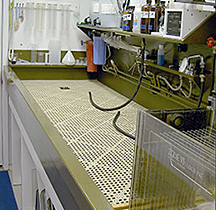 If you build you own darkroom sink or use a commercially available unit, you need something to protect the floor of the sink from scratches and abrasions. It has been a common practice to construct wooden Duck Boards for the bottom of the darkroom sink. These work well, they protect the sink, and allow water to drain, but wood is hard to waterproof and keep from warping.
I have heard of people using plastic lighting grids or plastic rods in the sink, but I have never tired them. I have constructed and used the usual wooden Duck Boards for years. Then I found something even better.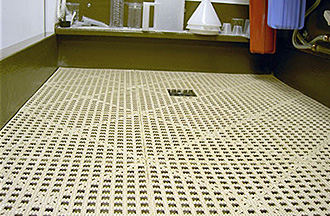
Dri-Dek® is sold as an anti-fatigue flooring for use in commercial work areas such as industrial manufacturing or commercial kitchens. It comes in 12” interlocking squares or rolls. This is a soft, flexible Vinyl that is perfect for the floor of a darkroom sink.
We installed Dri-Dek® in our sink two years ago and it has been an excellent investment. Water easily runs through and under the lattice work, it protects the sink floor, and it provides a soft, yet firm surface on which to work. Note, that the Vinyl does stain when exposed to some chemicals, like Amidol and Pyro, but it has remained flexible and I would not hesitate to recommend it to replace those old, warped wooden Duck Boards.
For more information about Dri-Dek® click HERE.
JB